
From Personal Collections to a Booming Trading Card Business
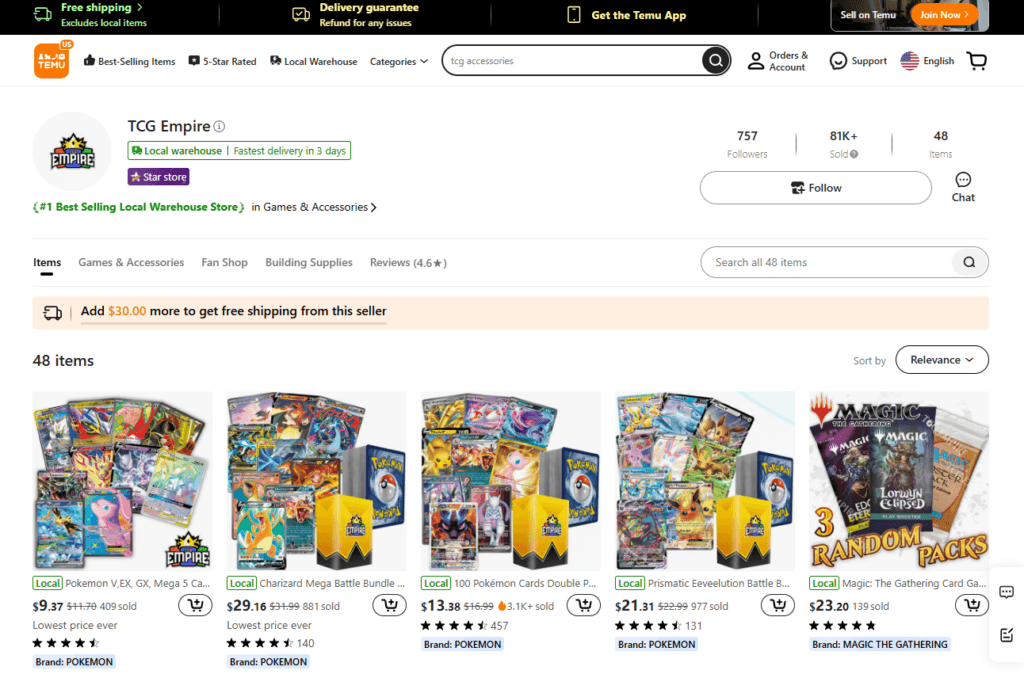
What begins as a hobby can sometimes evolve into something far greater than anyone anticipated. For the founders of TCG Empire, a passion for trading cards transformed from a personal pastime into one of the fastest-growing trading card businesses in the United States. The company, which started by merging the founders' own private collections and selling at local card shows, has since risen to become a leading seller on the Temu online marketplace — and it's just getting started.
To keep pace with rapidly increasing order volumes and customer demand, TCG Empire has taken a significant step forward: opening a dedicated warehouse. This move reflects not only the company's impressive growth trajectory but also the broader explosion of interest in trading card games (TCGs) across all demographics.
What Is TCG Empire and What Do They Sell?
TCG stands for Trading Card Game, and TCG Empire lives up to its name by offering a wide range of cards from some of the most beloved franchises in the hobby world. The company's catalog includes cards from Pokémon, Magic: The Gathering, Yu-Gi-Oh!, and One Piece — franchises that collectively command millions of dedicated collectors and competitive players worldwide.
However, as founder Joshua Howell candidly shared with Digital Commerce 360, the business is heavily anchored in one franchise in particular. "It's mostly Pokémon and the other things are ancillary," Howell explained. This focus on Pokémon is no accident. The Pokémon Trading Card Game remains one of the most consistently popular and commercially successful collectible card games ever created, with rare cards routinely selling for thousands of dollars and new set releases generating enormous consumer excitement.
The Origin Story: A Founder With 13 Years of Card-Flipping Experience
TCG Empire's story is rooted in genuine industry knowledge and hands-on experience. Joshua Howell launched the business in January 2024, drawing on more than 13 years of experience flipping trading cards on the side. Prior to founding TCG Empire, Howell had also worked for a different card company, giving him an inside look at how the trading card industry operates at scale.
By March 2024 — just two months after launching — TCG Empire had already established both a physical retail store and a functioning ecommerce website. This dual-channel approach allowed the company to serve local customers face-to-face while simultaneously reaching buyers across the country online. The speed at which the business got off the ground speaks to the preparation and market knowledge Howell brought to the venture from day one.
How Temu Became a Game-Changer for TCG Empire
While TCG Empire's early days were marked by the typical growing pains of any new business, things shifted dramatically once the company found its footing on multiple sales platforms — most notably, Temu. "At first, it was pretty slow, and then once we got a grasp of things, opened our own storefront and then got distribution for TCG products and then Temu," Howell told Digital Commerce 360. "Temu definitely helped us accelerate what we're doing."
Temu, the fast-growing international ecommerce marketplace known for its competitive pricing and massive user base, has become a surprisingly fertile ground for niche hobby sellers like TCG Empire. By listing products on Temu, TCG Empire gained access to a vast audience of potential buyers who might not have otherwise discovered the brand through traditional card-collecting channels. The platform's reach has played a pivotal role in driving the volume of orders that ultimately made warehouse expansion not just beneficial, but necessary.
A Multi-Platform Sales Strategy Built for Scale
One of the keys to TCG Empire's rapid growth is its deliberate multi-platform approach to ecommerce. Rather than relying solely on its own website, the company has strategically positioned itself across several major marketplaces to maximize visibility and sales volume. As Howell explained, "We really didn't focus much on our website because a lot of the sales are generated from other platforms because so many people use them."
Beyond Temu, TCG Empire is active on several well-established platforms that cater to both general shoppers and dedicated hobbyists, including:
- TCGPlayer — a marketplace specifically built around trading card games, making it a natural home for serious collectors and competitive players looking for specific cards.
- eBay — one of the world's largest and most trusted peer-to-peer and retail marketplaces, where trading cards have always had a strong and active buyer community.
- Amazon — the dominant force in US ecommerce, offering unmatched reach and logistics infrastructure that helps sellers fulfill orders quickly and reliably.
- Walmart Marketplace — an increasingly important ecommerce destination that connects sellers with millions of everyday shoppers who may be purchasing cards as gifts or exploring the hobby for the first time.
This diversified presence ensures that TCG Empire isn't overly dependent on any single channel and can capture demand from a wide variety of customer segments simultaneously.
Using the Website for Bulk Card Sourcing
While the TCG Empire website may not be the company's primary sales driver, it serves an important and strategic function: bulk card sourcing. The site features a dedicated form through which consumers can submit their bulk trading card collections for purchase. TCG Empire then buys those cards, replenishing its inventory with pre-owned stock that can be sorted, graded, and resold across its various marketplace listings.
This buy-back model creates a sustainable pipeline of inventory while also offering collectors and casual players an easy way to convert unwanted cards into cash. It's a smart circular economy approach that benefits both the business and its customer base.
The Warehouse Expansion: Meeting Demand Head-On
The decision to open a warehouse is perhaps the clearest signal yet that TCG Empire is thinking long-term. As order volumes from Temu and other platforms have grown, so too has the operational complexity of running the business. A dedicated warehouse provides the physical infrastructure needed to store larger quantities of inventory, process orders more efficiently, and prepare for continued growth.
For a company that launched just over a year ago, the pace of expansion is remarkable. From a merged personal collection sold at card shows to a multi-platform ecommerce operation with its own physical warehouse, TCG Empire's journey is a compelling example of how passion, industry knowledge, and smart marketplace strategy can combine to build something truly significant in a short span of time.
What TCG Empire's Growth Tells Us About the Trading Card Market
TCG Empire's rise is not happening in a vacuum. It reflects a broader and sustained surge in interest in trading card games and collectibles — a trend that accelerated during the pandemic and has shown no signs of slowing down. Pokémon cards in particular have become a mainstream cultural phenomenon, attracting not just children and teenagers but adult collectors, investors, and content creators who document their pulls and purchases for massive online audiences.
As the market continues to mature, businesses like TCG Empire that combine deep product knowledge, a multi-channel sales presence, and scalable logistics will be well-positioned to capture an outsized share of the growing demand. The warehouse opening is not just a logistical milestone — it's a statement of intent from a company that clearly has its sights set on becoming a major force in the trading card industry for years to come.