
How Rivian Turned Cost Reduction Into a Design Philosophy
In the competitive landscape of electric vehicles, most automakers try to win customers by adding more — more technology, more features, more complexity. Rivian took a strikingly different approach with the R2. Rather than piling on, the California-based EV maker asked a harder, more interesting question: what can we take away without anyone noticing? The answer, as it turns out, is quite a lot — and the result is one of the most thoughtfully designed electric SUVs to arrive in recent memory.
The Rivian R2 is not a stripped-down version of the larger R1S. It is, in many ways, something more ambitious: a vehicle where every cost-saving decision was treated as a design challenge. Rivian's team approached subtraction not as a compromise but as a craft, finding ways to reduce material, complexity, and price without sacrificing the premium feeling that defines the brand. The outcome is an SUV that feels far more expensive than its price tag suggests — and that is no accident.
The Philosophy Behind Subtraction as Design
Good design has long embraced the idea that simplicity is hard. Removing something without the loss being felt requires deep understanding of what actually creates value for the user. Rivian's designers understood this at a fundamental level when developing the R2. The brief was clear: bring the cost down significantly compared to the R1 platform while maintaining the brand's identity of rugged capability, modern aesthetics, and genuine quality.
What makes the R2's design story so compelling is the ingenuity behind the decisions. Rivian's team did not simply source cheaper materials or eliminate features arbitrarily. Instead, they rethought how things work from the ground up, using creative problem-solving and, perhaps most refreshingly, a sense of humor. The willingness to treat constraints as creative prompts — rather than obstacles — is evident throughout the vehicle, from its exterior lines to its interior details.
Exterior Design: Familiar Yet Fresh
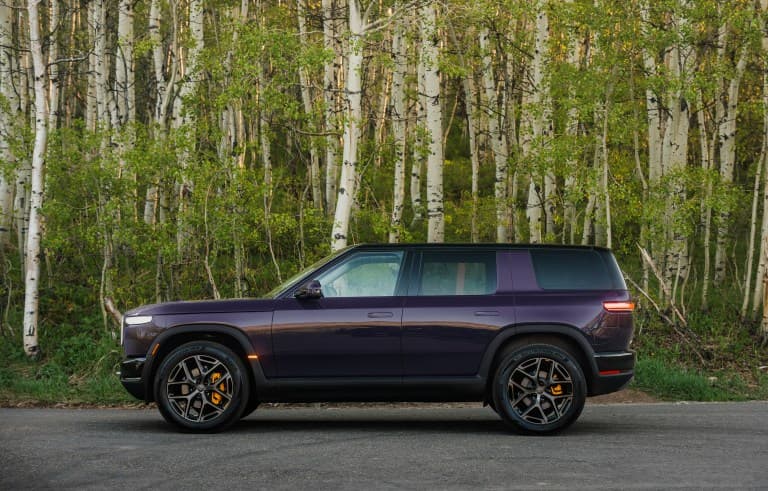
The R2's exterior immediately communicates that it belongs to the Rivian family. The signature front-end treatment, with its distinctive headlight graphic and broad hood, carries the visual DNA of the R1S and R1T into a smaller, more accessible package. But look closer and you begin to appreciate the clever edits.
Panel complexity has been reduced thoughtfully. Fewer character lines means fewer stamping dies, lower tooling costs, and a cleaner overall silhouette. Yet the R2 never looks cheap or plain. The proportions are confident, with a square-shouldered stance that hints at capability without resorting to theatrical cladding. The wheel arch flares are integrated cleanly, and the overall effect is an SUV that looks purposeful and premium at the same time.
Even the color palette reflects smart thinking. Rivian chose finishes that work beautifully at a lower production cost, yet photograph and present in person as richly as more expensive options. This is the kind of detail that separates brands that understand design from those that merely practice it.
Interior: Where Subtraction Becomes a Superpower
Step inside the R2 and the design ethos becomes even more apparent. The interior is clean, almost minimal, but it never feels sparse. Rivian's designers made careful decisions about where to invest and where to simplify, creating a cabin that feels coherent and considered rather than cost-cut.
The dashboard architecture is straightforward, centered around a well-placed infotainment screen and a simple horizontal layout that prioritizes usability. Physical controls are present where they matter most — a decision that drivers increasingly appreciate as the industry overcorrects toward touchscreen-only interfaces. The material choices are honest: textures and surfaces that do not pretend to be something they are not, yet still feel pleasant to touch and easy to maintain.
Storage solutions throughout the cabin show genuine ingenuity. Rather than relying on expensive mechanisms or complex folding systems, Rivian's team found elegant, low-cost ways to create useful spaces. Some of these solutions reportedly made the design team laugh during development — moments where the simplest answer turned out to be the best one, the kind of outcome that only emerges when designers are genuinely engaged with a problem rather than just executing a brief.
Why the Rivian R2 Matters for the EV Market
The Rivian R2 arrives at a pivotal moment for the electric vehicle industry. After years of premium-priced EVs dominating headlines, the market is hungry for vehicles that deliver genuine quality at a more accessible price point. The R2 is positioned to fill that gap in a way that does not ask buyers to accept obvious trade-offs.
- It brings Rivian's adventure-ready identity to a broader audience without diluting the brand's core values.
- It demonstrates that thoughtful engineering and design can achieve cost reductions that feel invisible to the end user.
- It challenges the assumption that affordable means ordinary, proving that constraints can produce innovation.
- It gives buyers a genuine alternative to the established compact electric SUV segment at a compelling price.
For consumers who have admired the R1S from a distance but found the price prohibitive, the R2 represents a genuine opportunity to enter the Rivian ecosystem without significant compromise. That is a difficult thing to achieve, and Rivian deserves credit for approaching it with the seriousness it requires.
The Bigger Lesson: Constraints Drive Creativity
The story of the Rivian R2 is ultimately a story about creative discipline. In an industry where feature bloat and spec-sheet competition often drive product decisions, Rivian chose a different path. By treating every cost constraint as a design opportunity, the team produced a vehicle that is arguably more interesting than it would have been with an unlimited budget. The R2 is proof that the best design solutions often come not from abundance, but from the productive tension of doing more with less.
As the EV market matures and price competition intensifies, the ability to subtract intelligently will become one of the most valuable skills in automotive design. Rivian, with the R2, has offered the industry a compelling lesson in exactly that. Whether competitors are paying attention remains to be seen — but for buyers, the beneficiary of all this clever thinking is clear.
Final Thoughts: An SUV That Earns Its Premium Feel
The Rivian R2 is not trying to be everything to everyone. It is a focused, well-considered vehicle that respects both the buyer's intelligence and their budget. The design team's willingness to embrace subtraction as a craft — rather than treating it as a limitation — has produced an SUV that stands out in a crowded market not because of what it has, but because of how thoughtfully everything within it was chosen. In a world of more, the R2 makes a quietly powerful case for less.