
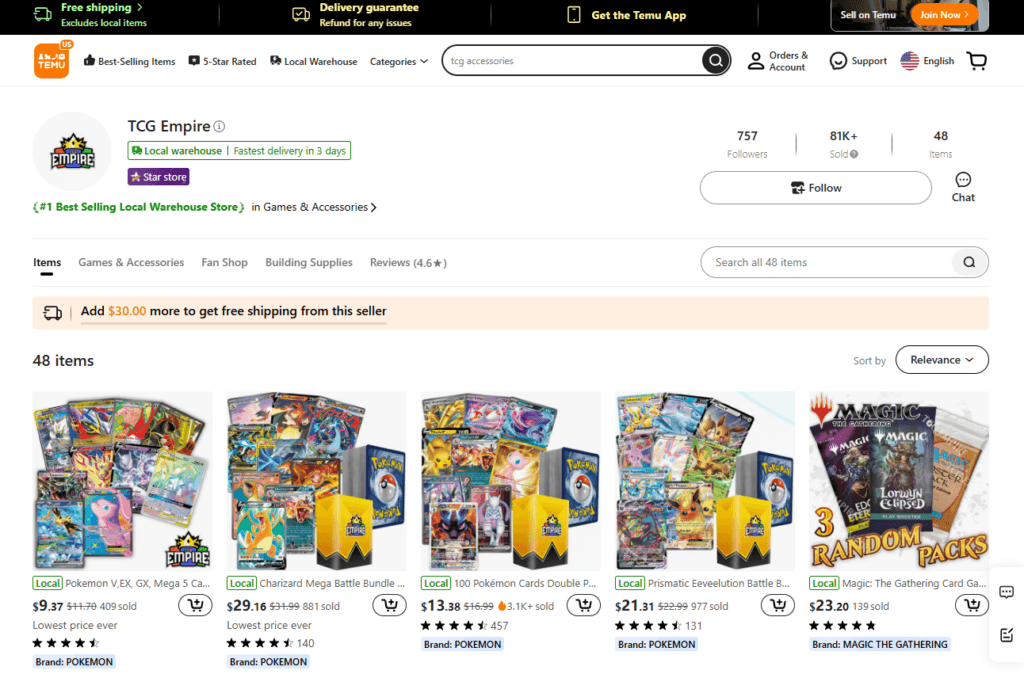
From Card Shows to Warehouses: The TCG Empire Story
What starts as a passion for collecting rarely ends up becoming a warehouse operation fulfilling thousands of orders through one of the fastest-growing online marketplaces in the world. Yet that is exactly what happened with TCG Empire, a trading card seller that has quickly risen to become a leading retailer on Temu. The story of TCG Empire is a compelling case study in how small businesses can leverage marketplace platforms to accelerate growth far beyond what a standalone ecommerce website might achieve on its own.
TCG stands for trading card game, and TCG Empire sells cards across some of the hobby's most beloved franchises, including Pokémon, Magic: The Gathering, Yu-Gi-Oh!, and One Piece. The business was founded by Joshua Howell in January 2024 after he had spent years working in the trading card industry — and 13 years flipping cards on the side. He merged his personal collection with those of fellow founders and began selling at card shows before eventually building something far more substantial.
A Fast Launch with a Multi-Channel Strategy
By March 2024 — just two months after launching — TCG Empire already had both a physical retail store and a dedicated ecommerce website. That's an impressive pace for any new business, and it reflects Howell's deep familiarity with the trading card market. But while many new entrepreneurs might focus obsessively on driving traffic to their own site, Howell took a different approach from the start.
"We really didn't focus much on our website because a lot of the sales are generated from other platforms because so many people use them," Howell told Digital Commerce 360. "It's easier to get your name out there if you're on, say, a website called TCG Player, which is all driven by trading cards. And then also eBay and then Amazon and also Walmart."
This marketplace-first philosophy is increasingly common among savvy ecommerce entrepreneurs. Rather than spending heavily on SEO, paid advertising, and brand-building just to attract customers to an unknown website, TCG Empire placed its products where buyers were already searching. The result was faster traction and a significantly shorter path to revenue.
Why Temu Became a Game-Changer for TCG Empire
Among all the platforms TCG Empire operates on, Temu has proven to be a standout growth driver. Howell was candid about its impact: "Temu definitely helped us accelerate what we're doing." That's a notable endorsement of a platform that has, since its North American launch in 2022, grown at a remarkable pace and attracted millions of price-conscious shoppers looking for deals across nearly every product category imaginable — including collectibles and hobby goods.
Temu's massive and rapidly expanding customer base gave TCG Empire exposure to buyers who might never have found them through organic search or even through more traditional card-selling platforms. As demand from Temu customers surged, the company faced the kind of challenge every growing ecommerce business hopes to encounter: it needed more space, more inventory, and better infrastructure to fulfill orders efficiently. The answer was opening a dedicated warehouse.
Opening a warehouse is a significant operational milestone for any small business. It signals that order volumes have outgrown whatever makeshift storage or small-space solutions were previously in place. For TCG Empire, it represents the transition from scrappy startup to serious retail operation — all within roughly a year of launching.
The Pokémon Effect: Why One Franchise Drives Most Sales
While TCG Empire carries a wide variety of trading card game products, Howell is straightforward about what actually moves the most inventory. "It's mostly Pokémon and the other things are ancillary," he explained. This is consistent with broader market trends. Pokémon Trading Card Game products have remained extraordinarily popular since a massive resurgence during the pandemic years, and demand has stayed elevated well beyond what many analysts initially expected.
For sellers in this space, Pokémon represents both a massive opportunity and a competitive challenge. The cards are widely sought after, but the market is also saturated with sellers at every level — from casual resellers flipping packs at flea markets to large-scale operations with dedicated inventory systems. TCG Empire's ability to secure product distribution for TCG goods has helped it maintain a reliable supply chain, which is a meaningful competitive advantage in a market where availability can be unpredictable.
Using the Website for Bulk Sourcing, Not Just Sales
One of the more creative aspects of TCG Empire's business model is how it uses its own ecommerce website. Rather than focusing primarily on outbound retail sales, the site serves as a bulk sourcing tool. Consumers can submit their collections through an online form, and TCG Empire purchases those bulk cards. This creates a steady inbound supply pipeline that feeds the company's resale inventory across all its marketplace channels.
This dual-purpose approach to the company website — part storefront, part acquisition engine — is a smart way to offset the costs of marketplace selling, where fees can cut into margins significantly. By buying cards directly from collectors, TCG Empire can source inventory at competitive prices while also providing a service that card owners find genuinely useful.
Lessons for Small Ecommerce Businesses from TCG Empire's Growth
TCG Empire's trajectory offers several practical takeaways for anyone building an ecommerce business in a niche hobby or collectibles market.
- Prioritize marketplace presence early. Selling on established platforms like Temu, eBay, Amazon, Walmart, and niche-specific sites like TCG Player puts products in front of existing, motivated buyers without requiring massive upfront marketing spend.
- Let demand justify infrastructure investment. TCG Empire opened its warehouse in response to real, sustained sales volume — not in anticipation of it. This capital-efficient approach reduces risk for early-stage businesses.
- Build creative sourcing pipelines. Using your own website as a bulk buying tool is an innovative way to control inventory costs while creating a value-added service for your customer community.
- Know your bestsellers. Howell's clarity that Pokémon drives the business allows TCG Empire to allocate procurement resources wisely rather than spreading inventory spend too thin across every available card franchise.
- Move fast, but stay grounded. Launching a physical store, a website, and multiple marketplace accounts within the first few months is ambitious — but Howell's 13 years of industry experience meant he wasn't learning from scratch. Domain expertise matters enormously when scaling quickly.
What's Next for TCG Empire
With a warehouse now open and Temu continuing to grow its North American user base, TCG Empire is well-positioned to keep scaling. The trading card market itself shows no signs of cooling off significantly, particularly for Pokémon, which continues to release high-demand sets that drive both casual and serious collectors back to the marketplace regularly.
As more consumers discover TCG Empire through platforms like Temu, the brand recognition the company is building — even indirectly through marketplace listings — will likely make its own website and direct sales channels more valuable over time. The foundation Joshua Howell and his co-founders built from merged personal collections has become something far larger than a hobby project. It is a growing ecommerce operation that demonstrates exactly how marketplace diversification, niche expertise, and smart sourcing strategies can turn a passion into a scalable business.