
The Summer Spending Paradox Nobody Is Talking About
As summer officially gets underway, the consumer spending landscape appears to be sending mixed signals. On one hand, the vast majority of American households are acutely aware that prices have gone up and that larger economic forces are creating headwinds for personal finances. On the other hand, most people aren't actually planning to spend less. How do we make sense of that contradiction?
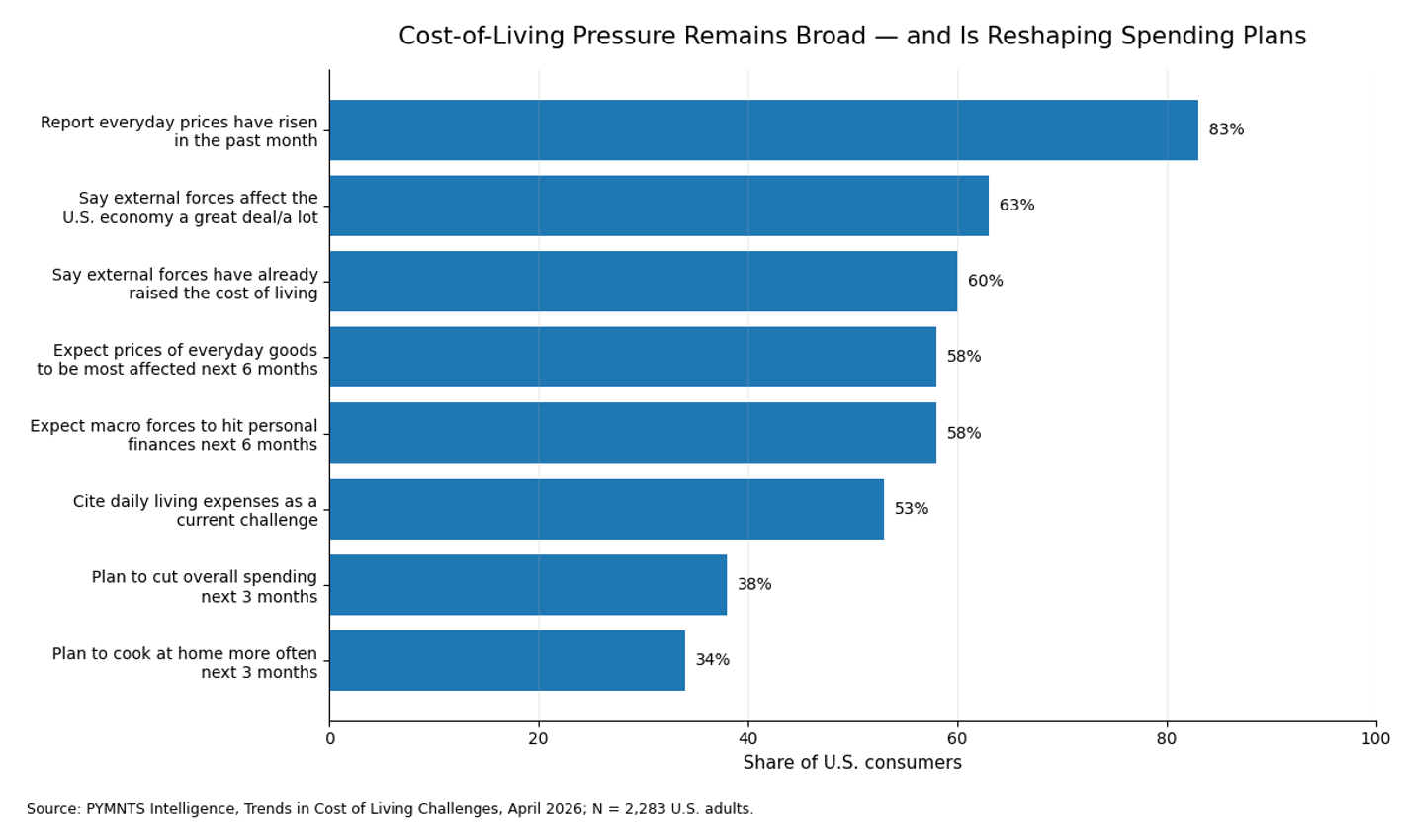
According to PYMNTS Intelligence research, 83% of consumers report that everyday prices have increased. Nearly two-thirds say that external economic forces — think tariffs, inflation, global uncertainty — are affecting the U.S. economy "a great deal" or "a lot." Fifty-eight percent expect those same forces to have a direct impact on their personal finances over the next six months. And yet, only 38% say they intend to reduce their spending over the next three months.
At first glance, those numbers seem almost impossible to reconcile. But dig a little deeper, and a clearer picture begins to emerge — one that has profound implications for retailers, financial institutions, and anyone trying to understand where consumer dollars will flow this summer.
Why Spending Behavior Defies Economic Logic
The conventional economic playbook suggests that when consumers feel financial pressure, they pull back on discretionary spending and protect essential categories. But that model assumes households define "essential" the same way economists, merchants, or card issuers do. Research increasingly shows they don't.
As PYMNTS CEO Karen Webster noted earlier this year, "essential isn't a characteristic of the expense. It's the characteristic of the person spending the money on it." That reframing is critical. A family vacation might look discretionary on a spreadsheet, but for a household that hasn't traveled in two years, it may feel as essential as groceries. A gym membership might seem like an easy cut from the outside, but for someone whose mental health depends on it, it's non-negotiable.
This means that consumer spending decisions this summer won't be driven purely by macroeconomic fear. They'll be driven by deeply personal hierarchies of value — the things households simply refuse to give up, regardless of what the economic headlines say.
What the Cutback Economy Data Really Reveals
The latest data from the Cutback Economy research series paints a picture of cost pressures that are real and widespread, but unevenly felt and differently managed. In the most recent survey, 53% of respondents cited daily living expenses — groceries, utilities, transportation — as a current financial challenge. Forty-four percent pointed to broader economic uncertainty as a concern weighing on their household planning.
These are not small numbers. More than half of consumers are feeling pinched by the basics of everyday life, and nearly half are watching the macro environment with active concern. So why aren't spending cuts more widespread?
The answer lies in how households are adapting rather than retreating. Rather than cutting across the board, many consumers are making surgical trade-offs: spending less in one category to protect another, trading down on brands while maintaining volume, or shifting timing rather than eliminating purchases altogether. This is the nuanced reality of modern consumer behavior — it's not a binary switch between spending and saving.
The Categories Consumers Are Protecting Most
Understanding which spending categories are most "sticky" — meaning consumers will fight hardest to preserve them — is essential for businesses trying to navigate this environment. While preferences vary by age, income, and household composition, research consistently points to several categories where consumers show the most resistance to cutbacks:
- Experiences and travel: After years of pandemic-era deprivation, many households have mentally categorized vacations and experiences as earned necessities rather than luxuries. Summer travel, in particular, carries emotional weight that makes it one of the last things families want to sacrifice.
- Health and wellness: Gym memberships, fitness classes, vitamins, and mental health services have seen sustained demand even as other discretionary categories contract. For a growing share of consumers, these aren't indulgences — they're part of a non-negotiable self-care routine.
- Dining and social connection: Meals out with friends and family serve a social function that is difficult to replicate at home. While consumers may opt for lower price points — choosing a casual restaurant over a fine dining experience — they're often reluctant to eliminate this category entirely.
- Children's activities and education: Parents consistently rank spending on their children's enrichment as among the hardest to cut. Sports leagues, summer camps, and tutoring programs tend to hold up even when household budgets tighten elsewhere.
What This Means for Businesses This Summer
For brands and retailers, the strategic takeaway from this spending landscape is both challenging and clarifying. The opportunity isn't to chase every consumer dollar — it's to become one of the things that households refuse to give up. That requires a deep understanding of the emotional and functional role your product or service plays in customers' lives.
Businesses that communicate value in terms of what customers gain — connection, health, joy, memories — rather than simply what they spend will be better positioned to hold consumer loyalty during economically uncertain periods. Price promotions alone won't be enough if customers don't see a product as personally essential.
On the financial services side, lenders and card issuers should similarly pay attention to how spending patterns are shifting rather than simply declining. Consumers may be redirecting dollars more than reducing them, and understanding those flows can reveal both risk signals and new opportunities for engagement.
The Bottom Line on Summer Spending
The summer of 2025 will not be defined by a consumer spending collapse. Most households are not preparing to hunker down and stop spending — they're preparing to spend differently, more deliberately, and on the things that matter most to them individually. Economic anxiety and consumer spending can absolutely coexist, and right now, they are.
For anyone trying to forecast, serve, or understand today's consumer, the most important question isn't "will they spend?" It's "what will they absolutely refuse to stop spending on?" The answers to that question will tell you far more about where this summer's economy is headed than any broad macroeconomic indicator ever could.