
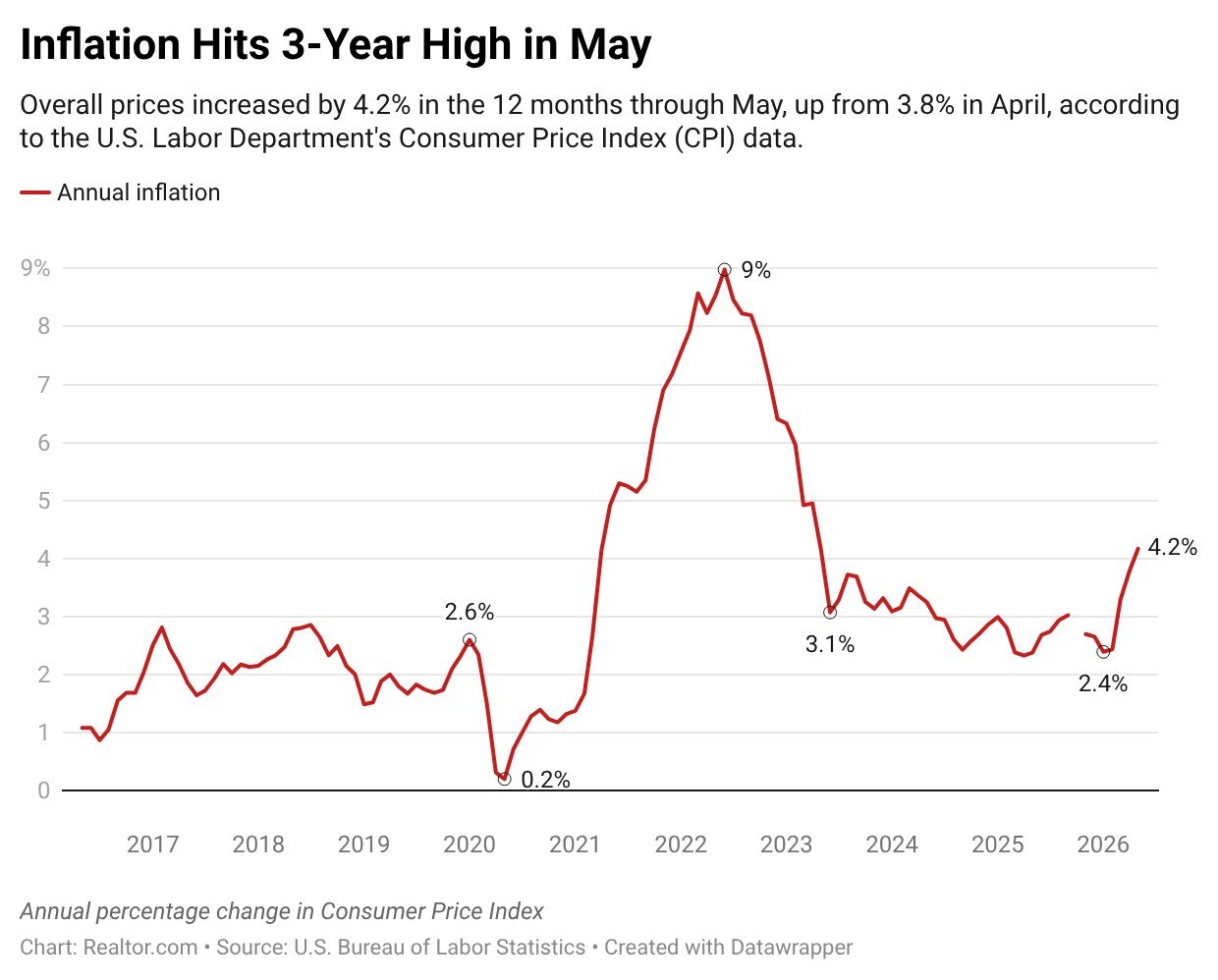
US Inflation Hits a Three-Year High of 4.2% in May
American consumers are feeling the pinch at the gas pump, the grocery store, and the housing market — and the latest government data confirms what many households have already been experiencing firsthand. Overall inflation in the United States climbed to 4.2% in the 12 months through May, according to the Consumer Price Index (CPI) data released Wednesday by the U.S. Labor Department. That marks the highest inflation reading since April 2023 and a notable jump from the 3.8% recorded in April. The figure matched economist expectations but nonetheless landed with significant weight, arriving just days before the Federal Reserve's closely watched policy meeting.
The primary culprit behind this acceleration is energy. Surging oil prices pushed the energy index up 3.9% in May alone, following a 3.8% rise in April and a dramatic 10.9% spike in March. Taken together, energy costs accounted for more than 60% of the monthly inflation increase — a staggering concentration that underscores just how exposed the broader economy remains to shifts in global oil markets.
Breaking Down the Numbers: Energy, Groceries, and Housing
The details within the May CPI report paint a vivid picture of where American consumers are being squeezed the hardest. Gasoline prices of all types surged 40.5% compared to the same period a year ago, and climbed an additional 7% just from April to May. Fuel oil posted an even more eye-watering annual gain of 58.9%, reflecting the broader volatility in global energy supply chains that has persisted through much of 2025.
Beyond the pump, everyday expenses continued their upward march. Grocery prices — heavily tied to transportation costs that are themselves sensitive to fuel prices — rose 2.7% year over year. Housing costs, one of the most closely tracked components of the CPI given their direct impact on household budgets, increased 3.4% over the 12 months through May. For renters and homeowners alike, this sustained rise in shelter costs remains one of the most persistent and painful aspects of the current inflationary environment.
On a monthly basis, headline inflation ticked up 0.6% on a seasonally adjusted basis in May. While that single-month figure might appear modest in isolation, its cumulative effect alongside previous months of elevated prices is significant for workers whose wages have not kept pace with rising costs.
Core Inflation Remains Stubborn Above the Fed's Target
Perhaps the most consequential data point for Federal Reserve policymakers is core inflation, which strips out volatile food and energy prices to give a cleaner read on underlying price pressures in the economy. Core inflation rose 2.9% year over year in May, edging up from 2.8% in April, and climbed 0.2% on a monthly basis. While that figure remains below the headline rate, it is still well above the Fed's long-stated target of 2% — and it is moving in the wrong direction.
The persistence of core inflation above target is a red flag for Fed officials who had been hoping that price pressures would ease more decisively by mid-2025. Instead, even after removing the distorting effects of energy market volatility, underlying inflation is proving stubborn, complicating the calculus for any potential interest rate adjustments.
The Federal Reserve's Dilemma: Cut, Hold, or Hike?
The timing of this inflation report could hardly be more consequential. The Federal Reserve is set to hold its next policy meeting in the coming days, and the May CPI data has thrown a fresh layer of complexity onto an already difficult decision-making environment. The central bank faces a genuine and uncomfortable dilemma on multiple fronts.
- Cutting interest rates would provide relief to borrowers and stimulate economic activity, but doing so while inflation is rising — and now sitting at a three-year high — risks being seen as premature and could allow price pressures to become further entrenched.
- Holding rates steady preserves the Fed's credibility and buys time to assess whether the energy-driven inflation spike is temporary or a sign of something more durable, but it does nothing to address mounting pressure on consumers and businesses already strained by high borrowing costs.
- Raising rates further would send a hawkish signal and could help cool demand-driven inflation, but higher rates also risk slowing economic growth, tightening already stressed credit markets, and increasing the cost of mortgages at a time when housing affordability is already a serious concern.
Fed Chair Jerome Powell and the Federal Open Market Committee (FOMC) must weigh all of these trade-offs carefully. Markets will be watching not just the rate decision itself, but the language and tone of any accompanying statement for signals about the path ahead.
What This Means for Mortgage Rates and Housing
For prospective homebuyers and current homeowners with variable-rate mortgages, the inflation surge adds fresh uncertainty to an already challenging housing market. Higher oil prices have historically contributed to broader cost increases throughout the economy, including construction materials and transportation — factors that feed into home prices over time. With housing costs already up 3.4% year over year, affordability continues to be one of the most pressing concerns for American families considering a home purchase or refinance in 2025.
If the Fed opts to hold or raise rates in response to the May CPI data, mortgage rates are unlikely to fall meaningfully in the near term. Buyers who have been waiting on the sidelines hoping for rate relief may need to recalibrate their timelines and expectations.
Looking Ahead: Is This Inflation Spike Temporary?
A key question economists and investors are wrestling with is whether this inflation surge is a temporary, energy-driven blip or the beginning of a renewed upward trend. The concentration of May's inflation in energy costs — accounting for over 60% of the monthly increase — could be interpreted as a hopeful sign that once oil prices stabilize, headline inflation may moderate naturally. However, the concurrent rise in core inflation, grocery prices, and housing costs suggests that the broader inflationary environment is not solely dependent on energy markets.
The Federal Reserve's response in the coming days will be one of the most consequential monetary policy decisions of 2025. Whether policymakers choose to act boldly or hold their ground, the May CPI data has made one thing unmistakably clear: the fight against inflation is far from over, and the road back to the Fed's 2% target remains long and uncertain.