
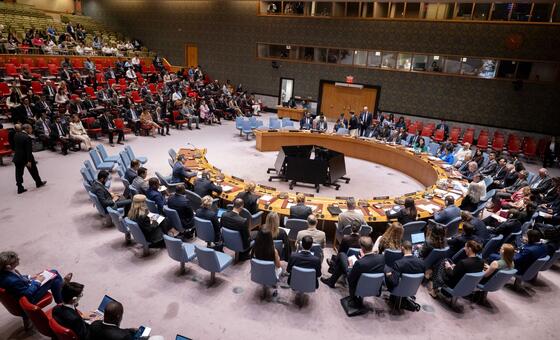
Middle East Crisis: UN Security Council Calls for Political Solutions as Tensions Reverberate Globally
Nearly four months after the latest Middle East crisis erupted, the region remains at a dangerous crossroads. Despite a fragile ceasefire between the United States and Iran offering a brief moment of cautious relief, tensions across the Middle East continue to reverberate far beyond regional borders. In response to the deepening instability, the United Nations Security Council convened a high-level debate on Wednesday to advance political solutions — a meeting that underscored just how urgently the international community views the situation.
UN Secretary-General António Guterres issued a stark warning, noting that the escalation is reverberating "across borders and continents," signaling that what unfolds in the Middle East does not stay contained within the region. For policymakers, analysts, and citizens worldwide, understanding the dimensions of this crisis — its humanitarian toll, its diplomatic dynamics, and its geopolitical stakes — has never been more important.
What Triggered the Latest Middle East Crisis?
The current wave of instability traces its origins to a series of escalating military, political, and humanitarian flashpoints that began converging roughly four months ago. While the Middle East has historically been a region of complex and overlapping conflicts, the latest crisis has drawn in multiple state and non-state actors simultaneously, stretching the capacity of international institutions to mediate effectively.
The fragile ceasefire reached between the United States and Iran represents one of the most closely watched diplomatic developments in recent months. For decades, US-Iran tensions have served as an underlying driver of regional volatility — fueling proxy conflicts, shaping alliances, and influencing the posture of governments from Beirut to Baghdad. While the ceasefire offers a degree of short-term de-escalation, experts warn that without a durable political framework, the underlying causes of hostility remain unaddressed.
The UN Security Council's Role in Seeking Stability
The United Nations Security Council has historically played a central role in managing international conflicts, and its high-level debate on the Middle East represents a significant moment of multilateral engagement. Wednesday's session was notable not only for its timing — coming amid active conflicts and humanitarian emergencies — but also for its stated aim: advancing political, rather than purely military, solutions.
This distinction matters enormously. Military interventions and ceasefires can pause violence, but without a corresponding political process, they rarely produce lasting peace. The Security Council's focus on political solutions signals a recognition that the path forward requires dialogue, compromise, and the rebuilding of trust between deeply divided parties.
Key issues on the agenda include humanitarian access in conflict zones, the protection of civilian populations, and the need to prevent further regional spillover. Member states with influence in the region — including permanent members of the Council — face pressure to use their leverage constructively rather than allowing geopolitical rivalries to block effective action.
Humanitarian Emergency: A Crisis Within the Crisis
Alongside the political and military dimensions of the conflict, the humanitarian situation across parts of the Middle East has reached critical levels. Displacement, food insecurity, damaged infrastructure, and constrained access for aid organizations have created conditions that humanitarian agencies describe as deeply alarming.
Civilians bear the heaviest burden in any prolonged conflict, and the current crisis is no exception. Families displaced from their homes, children unable to attend school, and populations cut off from basic medical care represent the human cost behind the diplomatic communiqués and Security Council debates. International relief organizations have repeatedly called for sustained, unimpeded access to deliver life-saving assistance to those most in need.
- Millions of people in conflict-affected areas are facing acute humanitarian needs, including food, water, and shelter.
- Displacement has surged, with refugee flows putting pressure on neighboring countries and stressing regional infrastructure.
- Medical facilities in conflict zones have reported critical shortages of supplies and personnel, limiting their ability to respond to casualties.
- Humanitarian corridors remain contested, with access subject to ongoing negotiation between warring parties.
The intersection of active conflict with pre-existing humanitarian vulnerabilities creates a compounding effect that makes recovery significantly harder — even after hostilities eventually subside.
Why Regional Stability Matters Beyond the Middle East
The UN Secretary-General's warning that escalation reverberates across borders and continents is more than diplomatic rhetoric — it reflects a measurable reality. The Middle East sits at the intersection of major global energy supply chains, shipping lanes, and migration corridors. Disruptions in the region ripple outward in the form of higher oil prices, destabilized supply chains, refugee flows toward Europe and beyond, and heightened risks of radicalization and terrorism.
For global economies already navigating post-pandemic pressures and inflationary headwinds, prolonged instability in the Middle East adds another layer of unpredictability. Financial markets, energy policy, and foreign investment decisions are all sensitive to signals emerging from the region — meaning that what happens in the Middle East has tangible consequences for households and businesses far removed from the conflict itself.
The Path Forward: Diplomacy as the Only Durable Solution
Experienced diplomats and conflict resolution experts broadly agree that there is no sustainable military solution to the complex web of grievances, rivalries, and historical tensions that define the Middle East landscape. The UN Security Council's emphasis on political pathways reflects this understanding — and the international community's growing impatience with cycles of violence that deliver neither justice nor lasting security.
What is needed is sustained diplomatic engagement, inclusive peace processes that incorporate the voices of civilian populations, and firm commitments from regional and global powers to prioritize stability over short-term strategic advantage. The fragile US-Iran ceasefire, while imperfect, demonstrates that even deeply adversarial parties can find moments of de-escalation when interests align. Building on such moments — carefully, persistently, and with genuine political will — represents the best available path toward a more stable Middle East.
As the Security Council continues its deliberations, the world will be watching closely. The decisions made — or deferred — in diplomatic chambers over the coming weeks and months will shape the trajectory of one of the world's most consequential regions for years to come.