
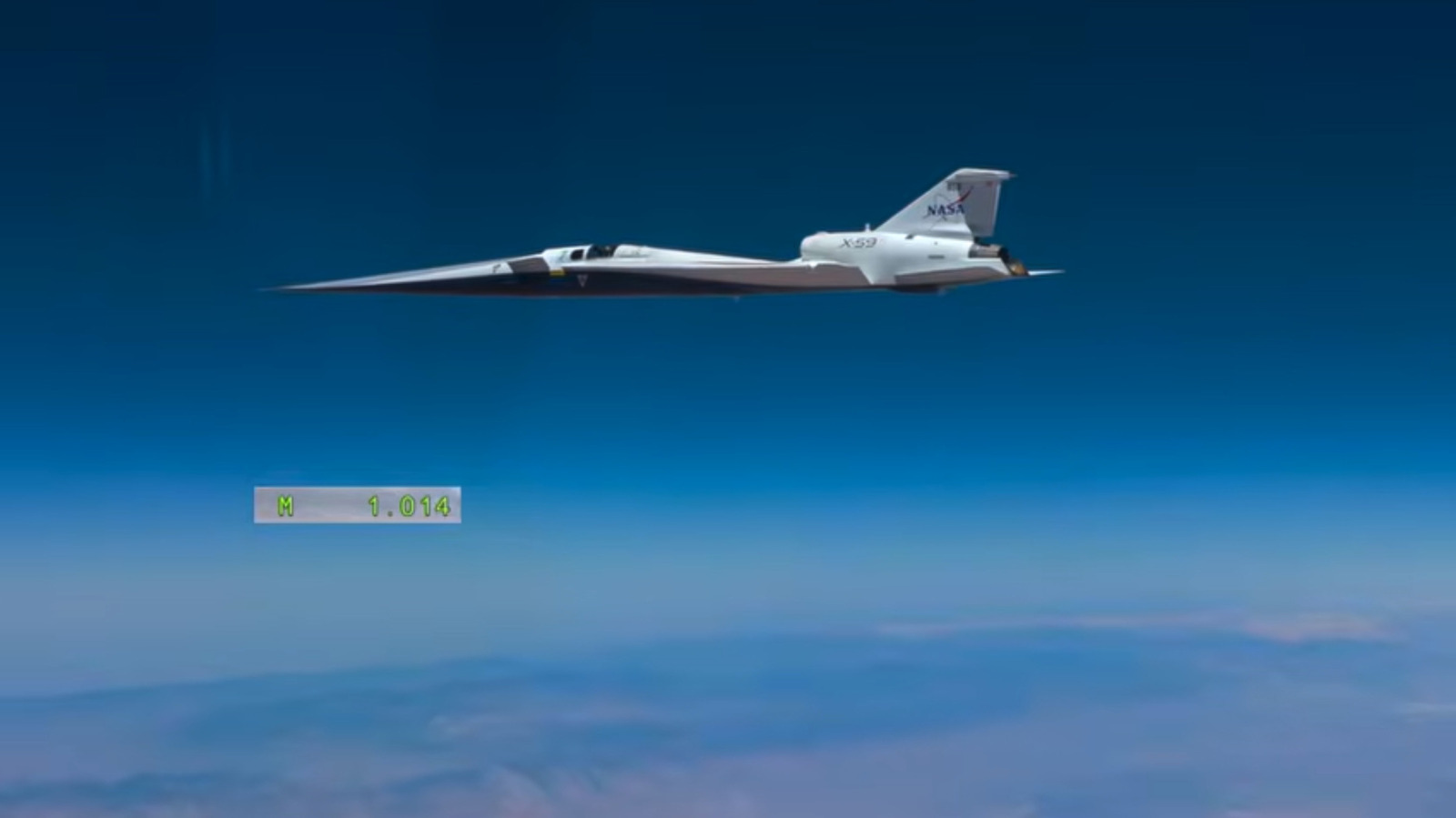
NASA's X-59 Achieves a Milestone: The First Supersonic Flight
For decades, the thunderous sonic boom produced by supersonic aircraft has stood as one of the greatest barriers to widespread faster-than-sound commercial travel over land. The ear-splitting crack rattled windows, startled communities, and ultimately led regulators to ban overland supersonic flight across the continental United States. Now, NASA is working to change that narrative entirely — and the X-59 experimental aircraft is at the heart of that mission. With its first supersonic flight now on the horizon and incremental milestones being crossed, NASA is inching closer to validating what engineers call the "sonic thump" theory: the idea that supersonic flight does not have to be loud.
What Is the X-59 and Why Does It Matter?
The X-59 is NASA's flagship experimental aircraft developed under the Quesst mission, a project carried out in partnership with Lockheed Martin's Skunk Works division. The aircraft has been purpose-built from the ground up to challenge one of aviation's most stubborn problems — the sonic boom. Everything about the X-59's design, from its needle-like elongated nose to the carefully sculpted fuselage, is engineered to manipulate shockwaves in a way that prevents them from merging into the single, powerful pressure wave that people on the ground experience as a boom.
The goal is not simply a quieter boom. NASA's ambition is to produce what researchers have been calling a "sonic thump" — a soft, muffled pulse that is barely noticeable to people on the ground. If successful, this proof of concept could fundamentally alter the regulatory landscape and open the door to overland supersonic commercial flights for the first time in modern aviation history.
Understanding the Sonic Boom Problem
To appreciate why the X-59 matters, it helps to understand what causes a sonic boom in the first place. When an aircraft breaks the sound barrier and travels faster than approximately 767 miles per hour at sea level, it generates shockwaves. On a conventional supersonic aircraft, those shockwaves coalesce into two powerful pressure fronts — one at the nose and one at the tail — that reach the ground as a double crack loud enough to reach 90 decibels or more. For context, that is roughly the volume of a motorcycle or a lawn mower right next to you.
This is the reason the Concorde, despite its elegance and speed, was restricted to supersonic travel only over the ocean. The sonic boom made it politically and socially impossible to fly faster than sound over populated land. The promise of rapid transatlantic travel never translated into transcontinental speed for paying passengers.
How the X-59 Reengineers the Shockwave
The X-59 attacks the sonic boom problem by keeping those shockwaves separated. Using computational fluid dynamics modeling and decades of aeronautical research, Lockheed Martin's team designed the aircraft so that the shockwaves generated at different points along the fuselage do not have the opportunity to merge before they reach the ground. Instead of combining into one powerful jolt, they arrive as a series of smaller, gentler pressure waves that humans on the ground perceive as a soft thump — if they notice it at all.
The aircraft's most distinctive physical feature supports this goal. Its nose cone is extraordinarily long, stretching so far forward that the cockpit has no forward-facing window. Instead, pilots navigate using an eXternal Vision System, or XVS, a high-resolution camera and display system that provides a synthesized view of the outside world. This unusual design is a direct consequence of the aerodynamic requirements for shockwave management.
The Path to Supersonic Testing
NASA's approach to validating the X-59 has been methodical. Ground tests, taxi runs, subsonic flights, and progressively higher-speed evaluations have all been stepping stones on the way to the supersonic milestone. Each phase has been used to verify systems, gather data, and confirm that the aircraft behaves as the simulations predicted. The incremental nature of the program reflects both the complexity of the engineering challenge and the high stakes of what NASA is trying to prove.
Once the X-59 achieves supersonic flight, the real experiment begins. NASA plans to fly the aircraft over several communities across the United States and survey residents about what they heard — or did not hear. This community response data is the linchpin of the entire Quesst mission. Regulatory bodies like the Federal Aviation Administration and international counterparts need real-world human perception data, not just instrument readings, to consider revising rules around supersonic overland flight.
What a Successful Outcome Could Mean for Aviation
The implications of a validated sonic thump theory are enormous for the future of commercial aviation. Several private companies, including Boom Supersonic and others, are already developing next-generation supersonic passenger aircraft. Those ventures are commercially viable only if they can fly over land. Without that capability, supersonic routes are limited, and the business case becomes difficult to sustain.
- Transcontinental flights could be dramatically shortened, with coast-to-coast travel potentially taking under three hours.
- New point-to-point supersonic routes over the continental United States could become commercially feasible for the first time since the Concorde era.
- International aviation regulations could be harmonized around new noise standards specifically designed for low-boom supersonic aircraft.
- The aerospace industry could see a wave of investment and innovation in supersonic propulsion and airframe design.
A Historic Moment in the Making
The X-59 represents more than an experimental aircraft — it represents a philosophical shift in how engineers and regulators approach the relationship between speed and community impact. For most of aviation history, going faster has meant accepting more noise, more disruption, and more restriction. The X-59 challenges that assumption directly.
If NASA's sonic thump theory holds up under real-world conditions, the aircraft will have done something remarkable: it will have turned a century-old aviation barrier into an engineering problem with a solution. The first supersonic flight is not the finish line. It is the beginning of the proof, and the world of air travel is watching closely.