
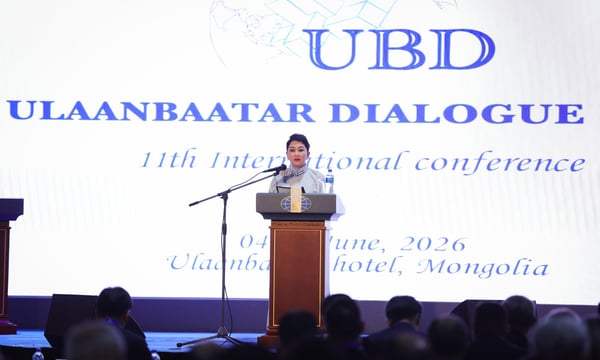
Mongolia at a Crossroads: Navigating Northeast Asia's Shifting Geopolitical Landscape
Sandwiched between two of the world's most powerful nations — Russia to the north and China to the south — Mongolia has long operated under the weight of geographic constraints that have shaped nearly every dimension of its foreign policy and economic strategy. For decades, the landlocked nation's options appeared limited, its trade routes dominated by neighbors whose political priorities rarely aligned with Mongolian interests. Yet as Northeast Asia enters a new era of geopolitical realignment, a compelling question is emerging among policymakers, economists, and regional analysts: can this shifting landscape finally create the opening Mongolia needs to diversify its economic partners and assert greater strategic autonomy?
The answer, while far from simple, is increasingly looking like a cautious yes — provided Mongolia moves deliberately, capitalizes on its unique positioning, and builds relationships with a wider constellation of partners before the window of opportunity narrows.
Understanding Northeast Asia's New Geopolitical Reality
The geopolitical architecture of Northeast Asia has been undergoing profound transformation. The war in Ukraine triggered sweeping Western sanctions against Russia, reshuffling energy trade flows and isolating Moscow from many of its traditional economic partners. Meanwhile, growing tensions between China and the United States have intensified competition over supply chains, critical minerals, and regional influence. South Korea, Japan, and Taiwan find themselves navigating an increasingly complex security environment, while North Korea continues to inject unpredictability into the region.
These disruptions, while destabilizing in many respects, are simultaneously creating new corridors of opportunity. Countries that were once peripheral to major strategic calculations are finding themselves newly relevant. Mongolia, with its vast mineral wealth, its historical relationships with both Moscow and Beijing, and its formal status as a "third neighbor" partner with democratic nations including the United States, Japan, and South Korea, sits in a uniquely advantageous position to exploit this moment.
Mongolia's Strategic Assets in a Multipolar World
To understand why Mongolia's moment may have arrived, it is worth examining what the country actually brings to the table. Mongolia holds some of the world's largest untapped deposits of coal, copper, gold, uranium, and rare earth elements. As the global energy transition accelerates demand for these critical minerals, Mongolia's subsoil resources have taken on extraordinary strategic value.
Beyond resources, Mongolia's geographic position between Russia and China makes it a potential transit corridor of significant importance. The country has long been discussed as a route for Russian natural gas pipelines heading toward Chinese markets, a project that could generate substantial transit revenues for Ulaanbaatar. More broadly, the revival of ancient Silk Road trade concepts and modern connectivity initiatives positions Mongolia as a land bridge linking East Asia with Central Asia and beyond.
Perhaps most importantly, Mongolia is a functioning democracy in a neighborhood dominated by authoritarian governance. This political identity opens doors with Western partners who are increasingly attentive to the democratic credentials of the nations they invest in and forge security relationships with.
Diversifying Economic Partners: The Core Opportunity
For most of its post-Soviet history, Mongolia's economy has been deeply dependent on China. The vast majority of Mongolian exports — particularly coal and copper concentrate — flow south across the border, making Beijing an overwhelmingly dominant economic partner. This dependence has not always served Mongolia well. Trade disputes, border closures during the COVID-19 pandemic, and price volatility have repeatedly exposed the vulnerability of an economy with too few trading partners.
The new geopolitical environment is, for the first time in recent memory, generating genuine momentum behind efforts to change this dynamic. Japanese and South Korean companies have shown growing interest in Mongolia's rare earth and critical mineral sectors, driven by their own governments' desire to reduce dependence on Chinese supply chains. The European Union has been deepening its critical minerals diplomacy across Central and Northeast Asia, and Mongolia has emerged as a country of interest in those conversations. The United States has also signaled greater strategic attention toward Ulaanbaatar through diplomatic engagements and development financing.
If Mongolia can successfully leverage these relationships into concrete investment agreements, infrastructure development, and long-term offtake contracts, it could meaningfully reduce the share of its economic output that flows through a single partner — a critical step toward economic resilience.
Challenges Mongolia Must Overcome
Opportunity, however, rarely arrives without friction. Mongolia faces significant structural challenges that could limit its ability to fully capitalize on this geopolitical moment. Infrastructure remains a serious constraint: rail connections are limited, roads are poor in many mining regions, and the country lacks the export terminals, processing facilities, and logistics networks that would allow it to quickly scale up trade with new partners. Addressing these gaps requires enormous capital investment that Mongolia cannot generate domestically.
Governance and corruption concerns also remain a recurring issue that deters some foreign investors. Mongolia has made progress on democratic institutions, but regulatory unpredictability and resource nationalism have at times complicated the investment climate in the extractive industries that form the backbone of its export economy.
Geopolitically, Mongolia must also manage the inherent delicacy of deepening ties with Western and Asian democratic partners without provoking a hostile response from Russia or China, whose geographic stranglehold over Mongolian trade routes gives them significant leverage.
The Path Forward: Strategic Patience and Bold Diplomacy
The window of opportunity now open to Mongolia will not remain open indefinitely. Regional geopolitics could stabilize in ways that reduce Mongolia's strategic relevance, or new crises could close trade corridors before infrastructure is built. What Mongolia needs is a combination of strategic patience and bold, proactive diplomacy — using its democratic identity, its mineral endowment, and its transit potential to negotiate from a position of growing strength rather than perpetual dependency.
The nation's "third neighbor" policy, long a conceptual framework, must now be translated into binding economic and security partnerships that deliver tangible benefits to ordinary Mongolians. That means accelerating negotiations with Japan, South Korea, the EU, and the United States on critical mineral agreements, infrastructure financing, and trade facilitation — while managing the complex relationship with Beijing and Moscow with equal care.
Northeast Asia's new geopolitical reality is undeniably turbulent. But for Mongolia, turbulence and opportunity have always arrived together. The question is whether Ulaanbaatar has the vision and the institutional capacity to seize this rare historical moment before it passes.